Design Operation
December 15, 2025
It’s a well-known truth that to develop a product that users truly love, you need to think about their needs, values and desires. This isn’t just about making your product as easy-to-use as possible, (though that’s important, with 70% of online businesses failing if usability is bad) but making sure it’s fully accessible, isn’t biased and helps them achieve their goals.
However, when a product is in development, other influences can quickly start to take over. Brand, stakeholder needs and market trends all need to be taken into account, but can soon start to take precedence over user needs if not kept in check. Teams using AI in the UX design process need to gatekeep against this influence, too.
Centering UX design around the human end user is the mission that drives our design everyday, and is central to how we work. So what does this approach look like and how can teams make sure they achieve it?
To achieve a human-centered product, our design team follows some core principles which guide our processes and decision-making.
There are no easy answers as to why users behave the way they do. The most important pain points you need to address can easily get lost in bigger challenges. Staying curious enough to find the real answers can help you take large amounts of user data or research and narrow down the specific insights you need. This helps us prioritize and solve what matters most to users.
This approach also helps us challenge any conventions, presumptions or expectations which could prevent us from effectively meeting user needs. At each stage of the product development process, we look into the details to make sure we understand users well enough to break through the noise and make the product intuitive for users.
Numbers are great, but qualitative information and expert insight give us a deeper understanding of what users really want and value. Although data can be a good indicator and starting point for decision-making, they’re only one part of the story. By being empathetic to a product’s audiences, UX designers can pick up on subtleties or nuances the data would otherwise miss.
Once research has been completed, designers can pick out and interpret the most powerful quotes that indicate slightly different user intent. For example, users might come to a hotel booking app with the same purpose (finding and reserving a room), but for one, it may be a stress purchase, while the other is driven by excitement.
Taking these insights into account, designers can then make choices about the features, visuals and messaging they need to use to reflect how users feel. This kind approach helps them build a more effective, intuitive product for all audience types.
By having a fully visible, carefully documented workflow, our team can make sure each design decision is justified by human value, not just an arbitrary choice. With any limitations or assumptions being addressed early on in the process, ideas, concepts and prototypes are built on evidence rather than guesswork. This clarity minimizes misinterpretations and wasted iterations.
This approach also helps to prove the reasoning behind designs to other stakeholders and the wider business. For example, by linking all research, notes and decision logs in Figma, developers can understand the user intent and build that into their work. This evidence also builds a stronger advocacy case for prioritizing user needs when business pressure grows.
By encouraging teamwork led by frankness rather than barriers or ego, our teams are able to work towards a common goal of creating human-centered designs rather than getting distracted by other priorities and ‘noise’. Getting diverse perspectives from different team members means any real-world limits or blind spots can be pinpointed early, leading to a more intuitive, resilient design.
With open questioning and opportunities for regular feedback, the team can also remain aligned towards meeting user intent across the whole process. It also makes continuous improvement possible, with everyone in the team holding responsibility for the final product and raising objections transparently before they cause disruptions or friction.
No product is ever complete. User requirements and behaviors change and UX needs to adapt accordingly to be successful. To continue elevating standards, we follow a continuous testing and learning process.
From the earliest concepts and prototypes to post-launch changes, any rationale can be put to the test and learnings can be integrated effectively. This ensures user needs are consistently met, whatever stage of maturity a product is at.
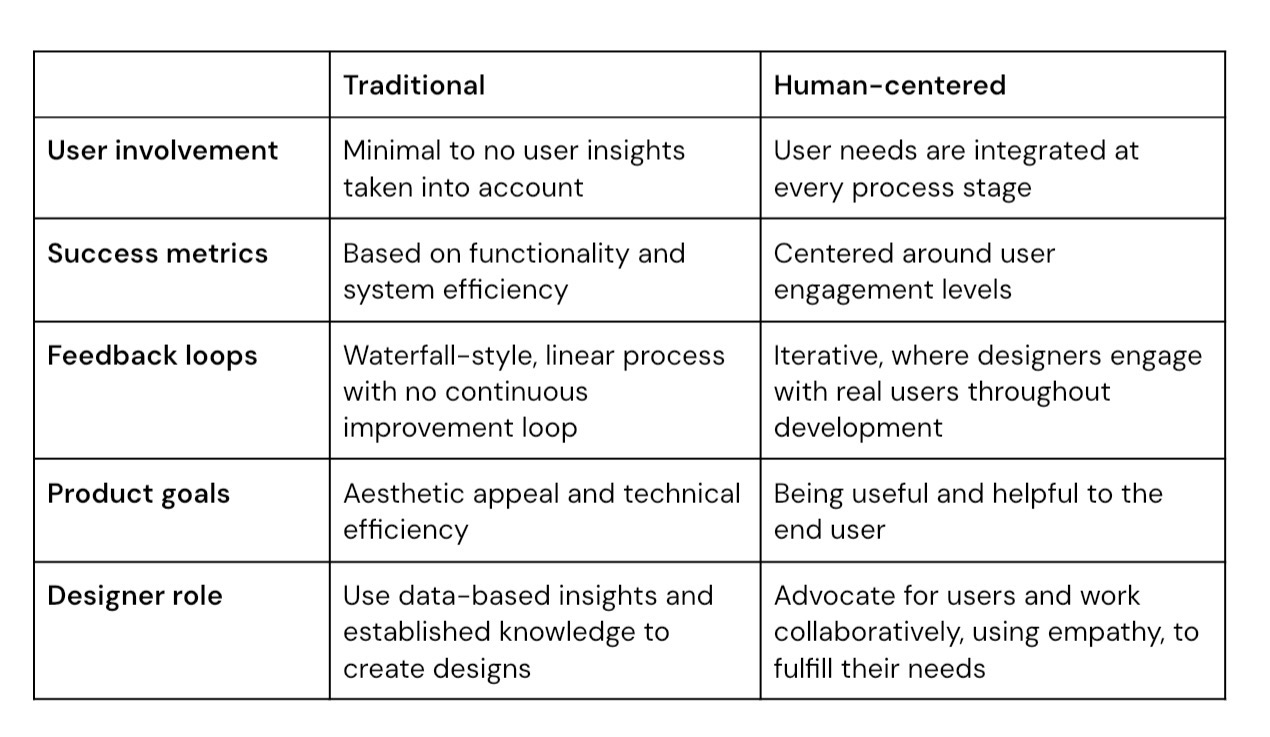
The approach and workflows of human-centered vs traditional UX design differ significantly. This is mainly because the former approach prioritizes user needs, while the latter focuses on the requirements of a business. This results in the following differences.
By taking a human-centered UX design approach, we’ve found that end users and our clients enjoy the following benefits:
As AI starts to be integrated more into the UX design process, protecting and advocating for human value becomes even more important. Otherwise, the nuanced, user-focused approach which brings huge benefits to the end product could be diminished in favour of greater efficiencies.
These technologies can offer benefits in terms of speeding up processes, taking on mundane tasks and spotting any gaps or inefficiencies. However, human design teams play a key role in maintaining creative standards, ensuring an empathetic approach and gatekeeping ethics and accuracy. All of which are key to an effective human-centered UX design process.
.svg)
.svg)
By subscribing, you agree to receive emails from Koi Studios. Unsubscribe anytime using the link in our emails.